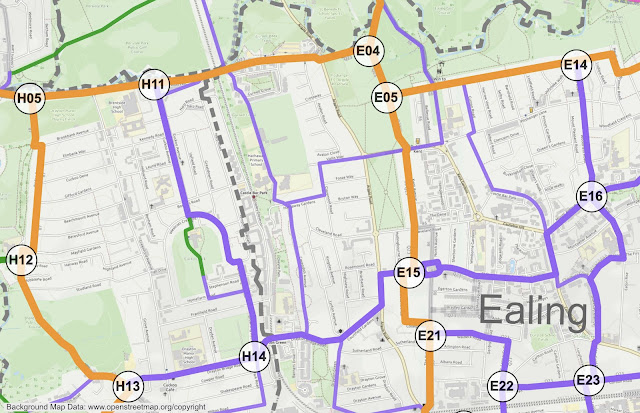
Work is now under way to create the schedule of links to help the council decide priorities and be reminded of the work that needs to be done on each link. You can see the latest position, including a map and explanatory notes, here.

For the full menu (on phones), click the small black triangle on the right next to "Home".

Cycling is widely recognised as having health benefits that vastly outweigh the accident risks inherent in two-wheeled travel. But will an e-bike give the same active travel health benefits as a traditional cycle? If you ride further, faster, or longer into old age as a result of having electrical assistance the answer might be yes. However the answer will depend partly on the type of sensor used to control the electrical input. There are two types available – torque (pedal force) sensor control and cadence (rotation) sensor control.
Torque sensors
With torque sensor control, the electrical input depends on how much effort the rider exerts on the pedals. The harder you push, the more assistance you get. The result is a ride that feels natural, but you seem to have the legs of a younger person. A button on the handlebar unit allows you to choose the ratio of electrical assistance to pedalling effort – do you want the legs of a 20, 40 or 60 year old? Importantly, if you're comfortably pedalling along a flat road, and not needing to make much effort to maintain a safe speed in traffic, the motor will add a correspondingly low level of assistance.
E-bikes with torque sensor control will also have some form of movement sensor, to make sure that assistance is only given when the bike is actually moving. The movement sensor will also ensure that no e-assistance is given when the bike is travelling above the legal limit of 25 km/h (15.5 mph).
Cadence sensors
With cadence sensor control, a fixed amount of power is added when the pedals are turning, regardless of how hard the pedals are being pushed. On privately owned models there is normally a handlebar control that allows you to decide the level of power input supplied, ranging from zero (off) to the maximum of 250 watts permitted for UK road use without the e-bike being treated as a motorbike. But the simplest rental e-bikes don't have the option of power level control – as soon as you start pedalling you get the full power assistance available, regardless of whether you need it. The only way to stop the assistance is to stop pedalling. This can make the bike harder to control at low speeds in traffic
The exercise difference
Because torque sensor controlled e-bikes only add power when it is actually needed, they use less electrical energy than e-bikes controlled by cadence sensor. As a result the useable range for a given battery capacity is greater. The extra battery energy used by cadence sensor controlled e-bikes is an indication of the exercise not being taken.
The extent to which cadence systems use more battery energy will depend on the terrain, and on the rider's ability to continually match a cadence sensor's power output to the level actually needed. But as an example, if a 500Wh battery lasts 4 hours with torque sensor control but only 3 hours with cadence sensor control, then on a 3 hour ride the cadence sensor bike will have used 125Wh more battery energy than the torque sensor bike. 125 watts is typically the energy output of an averagely fit adult cycling an unpowered bike. So on a 3 hour ride the cadence sensor rider will have lost the equivalent of one hour's exercise.
Rental e-bikes
Two of the three providers of rental e-bikes in Ealing (Lime and Voi) use only the simplest type of basic cadence control, without the option to vary the level of power input. Santander e-bikes in central London also have basic cadence control. These bikes offer the lowest exercise benefit of all e-bikes – it is too tempting to let the pedals gently coast round, with the motor doing most of the work. However the rider
will still benefit from the lower accident risk arising from the increasing number of people cycling in London, which has made motorists more aware of all types of cyclist. The rider will also benefit from gradually improving cycle infrastructure, including Ealing's borough-wide 20mph limit. If a rental e-bike journey is replacing one that would have been made by car, there are the low emission and congestion benefits. And cycling is often the fastest way to travel in Ealing, even without electrical assistance.
The good news is that the third Ealing provider, Forest, has confirmed that their e-bikes have torque sensor control, and thus can properly be classed as active travel. Outside London, the rental e-bikes provided by Beryl Bikes in cities such as Belfast and Brighton use torque sensor control, and give a noticeably better quality of ride than the Lime and Voi e-bikes in Ealing. There are many factors affecting which rental bike to choose, including availability, ease of using the app, riding comfort, and cycle weight, but all other things being equal a torque sensor controlled rental bike should give a better ride.
What is throttle control?
Some privately owned e-bikes have a throttle control that gives a low level of assistance when the bike is being pushed at a walking speed of up to 6 km/h (3.7 mph). This can be useful when, for example, pushing the bike up a subway ramp. It is illegal to use throttle control at speeds higher than 6 km/h on public roads unless the bike is numberplated, licensed and insured as a motor bike.
It is relatively easy to buy an e-bike that can use throttle control at much higher speeds than 6 km/h, usually sold as "for use on private land but not on public roads". The opportunities for using these bikes legally in Ealing are for practical purposes non-existent. Sadly the police don't usually have the resources to clamp down on the use of such bikes on the public highway, but they did carry out a successful enforcement in Ealing Broadway in August 2025 and confiscated a number of illegally modified e-bikes with throttle control.
Which type of e-bike should I buy?
If you can afford it, go for an e-bike that uses torque sensor control. The price difference from cadence control is narrowing, and you will enjoy the better ride quality and the health benefits of more exercise.
Bear in mind that some cycle shop salespeople don't realise that there is a choice of sensor type, or may tell you the point is just a technicality. A shop or website that sells both types won't go out of their way to point out the disadvantages of cadence control, if they think that price is likely to be a major factor determining whether a sale will be made.
If you are going to use the e-bike for touring or longer commutes, the greater battery range of torque sensor control can be a significant consideration.
One of the earliest countries to adopt the widespread use of e-cycles was Japan. Current legislation in Japan effectively only allows the use of torque sensors, as shown in this extract from the Yamaha website. The UK could usefully follow suit.

(This article was written for Ealing Cycling Campaign by Peter Mynors FICE FCIHT MTPS in January 2026. Peter has ridden the same bike with both types of sensor, at different times, which is the best way of comparing the two control systems.)
Work is now under way to create the schedule of links to help the council decide priorities and be reminded of the work that needs to be done on each link. You can see the latest position, including a map and explanatory notes, here.


The cycle path across Ealing Common has got an improved crossing at the western end (near The Grove). The raised speed table has been poured and had its white markings painted on in recent days. It's plenty wide enough for pedestrians and cycle riders to share.

You might remember that for a few years now a loop of roads in central London have been closed to motor traffic for a day, under the banner of 'London Freewheel', and Ealing Cycling Campaign has led groups of riders there and back. Great fun all round, especially for kids and those who wouldn't normally dream of riding round London's landmarks like The Mall.
Well, there won't be a 'London Freewheel' this year, but on 24th May there will be the London Festival of Cycling. Ealing Council is putting on two rides, the Ealing Park Rides, open to all, between Pitshanger Park and Churchfields Recreation Ground. They will be led by professional cycling instructors. Further details can be found here at this link.
<> <> <> <>

You don't expect the name of a football club as the headline of a cycle campaign news item, so I guess I should explain. One of our old friends not only cycles a lot to get from A to B but is a long-standing follower of his local club, Brentford. 'How about combining the two?' he thought, and 18 months ago two supporters came together to form a new fans' group called 'Sustaina-Bees', he began to lead official bike rides to Brentford's home games and the London away games, and it caught on. In fact, it caught on so well that the club has hired professional ride leaders, leading four separate rides from Acton, Ealing Broadway, Hounslow East and Richmond, each being led back 15 to 30 minutes after the match. There is now secure, covered, parking for 300 bikes by the ground, watched over by Brentford FC staff. UEFA and the FSA (Football Supporters' Association) have noticed too and given it a mention: good news can travel!
For the game against Manchester United on May 4th people cycling to the stadium will receive a voucher for food (important to cyclists, as we all know) and a drink too.
More details here https://www.brentfordfc.com/en/travel-to-the-stadium
Well done Bicycle Ben!
Ealing Council has published a future cycle network plan of the borough. It is not a map of routes you can ride on now. Some are fine, but others are terrible. Instead, it shows the routes the council will work on improving between now and 2035. The aim is to raise the quality of these routes to the London Cycling Design Standards and the national standards set down in Local Transport Note 1/20. The plan is a requirement of Ealing's Local Plan which has to meet the Mayor of London's target for 40 percent of Londoners to live within 400m of the cycleway network by 2030, and 70 percent by 2041.
Routes in orange are core routes. Purple indicates neighbourhood routes and pink shows key routes that, due to constraints such as narrow width and volume of traffic, it will not be possible to upgrade to the national standards but, where possible, improvements will be made. Green routes are routes through parks and other green spaces.
The map was developed with the help of a wide public consultation. 1,118 residents took part making 1,814 suggestions for improvements. Ealing Cycling Campaign lobbied for high quality routes that cyclists of all abilities could use and for strategic routes not to run in remote, unlit areas. The council has adopted many of our suggestions, and most of the canal towpath is now designated as a green route.
The network is largely a planning tool. It will help planners avoid installing obstructions, such as electric vehicle charging points, where they will later have to be removed to install a cycle lane. It will also indicate where any new developments will need to moved back from the road to create space for protected lanes.
To build the network, priority is likely to be given to routes that are designated as top and high priority on TfL's Strategic Cycling Analysis as these are routes that TfL is most likely to fund (below). The Uxbridge Road is the top potential corridor in Ealing.

To help assess the quality of existing routes and what needs to be done to improve them, ECC has produced a node network of key routes on the new network plan. Completing the core (orange) routes will put over 40 percent of residents within 400m of a cycle route.

Adding the highlighted neighbourhood (purple routes) and completing the node network will put nearly all residents within 400m of a cycle route with good connections across Ealing.

Earlier this month, Ealing council opened a new cycle parking hub near Southall Station. Funded by Transport for London as part of the Crossrail improvements, the new hub has room for 70 bikes. The hub is a 2 minute walk south of the station on the corner of South Road and Merrick Road.

The parking is on two levels, and all but four spaces are under cover.


